Freezer Repair
Your Swamp Cooler Is Why the Sub-Zero Is Sweating: Summer Condensation and Gasket Mould in Park Hill and University
- Written by
- Tobias Reinhardt
- Trade
- Refrigeration technician — doors, gaskets and cabinet fit · 9 years in the trade
- Certified
- EPA Section 608 certified
The question worth asking first
Not what is wrong with it — when it started. Denverite reported in June 2025 that roughly 30% of Denver households still have no cooling, and the long-standing local substitute is the evaporative cooler: a machine that works by adding moisture to indoor air and drawing it through open windows. If your built-in only sweats in summer, that is your first suspect.
Seasonality is a genuine diagnostic. A sealed-system fault does not politely disappear in September. A gasket that beads with water from the week the cooler is fired up and dries out the week it is drained has been told to do that by the room, and no part inside the cabinet will change its mind.
What shortens an appliance life here specifically
An evaporative cooler does two things a compressor-based system never does. It raises the absolute humidity indoors rather than wringing it out, and it maintains a continuous one-way flow of unfiltered outside air through the house, because it needs open windows to exhaust. Both of those land on refrigeration.
The moisture shows up first at the coldest exposed metal, which is the door frame and the mullion between compartments. Sub-Zero fits anti-condensation heating there precisely so surfaces stay above dew point, and in a swamp-cooled July that circuit is being asked to work far above what a dry Denver spring demands. The extra run time it causes gets reported to us as a machine that never rests, and it is very easily mistaken for a failing compressor.
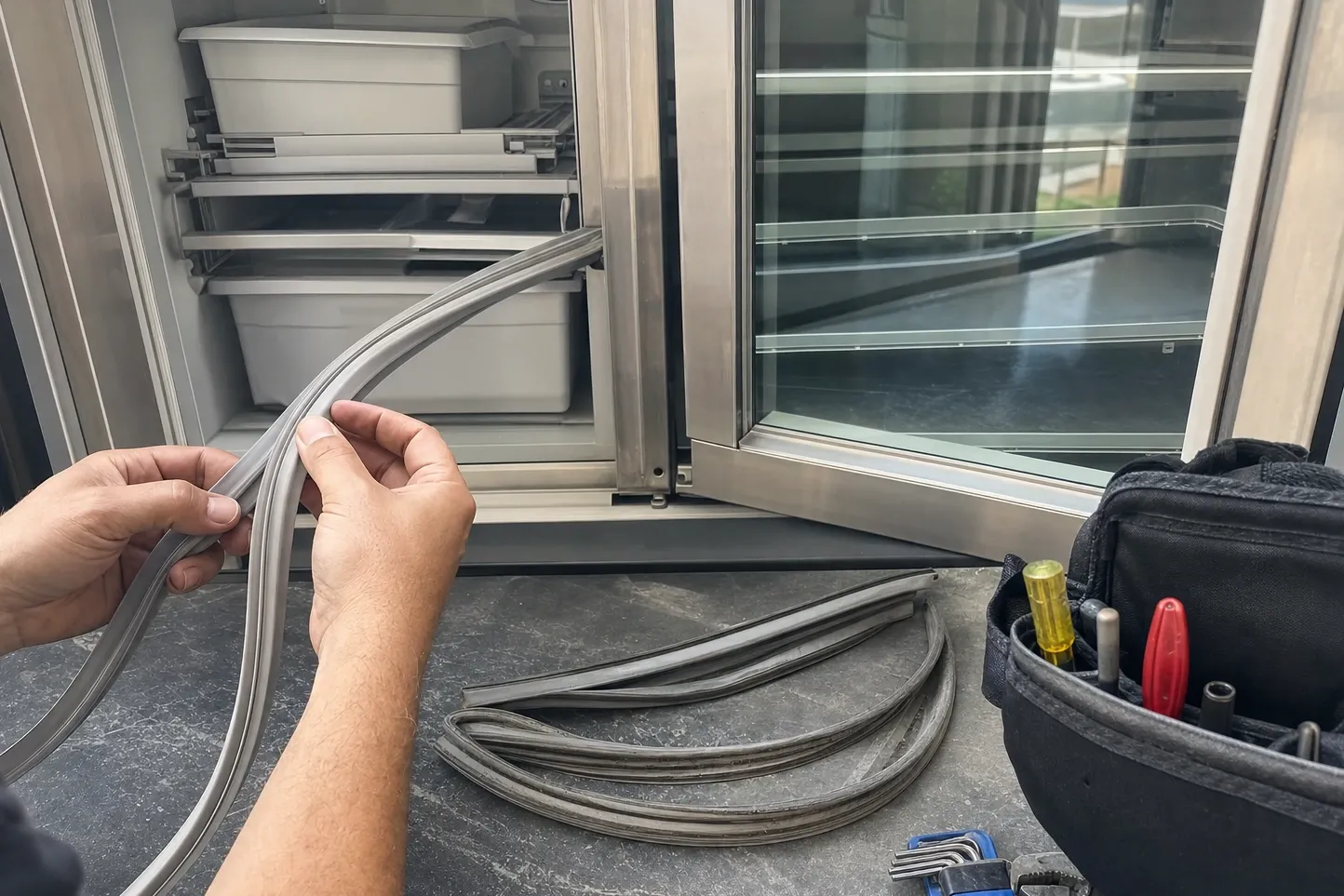
The gasket channel is the second casualty. It is a shaded, folded, permanently damp rubber trough in a room whose humidity has been raised on purpose, and black colonisation along the fold is routine here by August. In a freezer compartment the same humid air arrives on every door opening, which is why frost returns to the rear panel within days of a manual defrost — the defrost system is not failing, it is being fed.
The third is airflow you cannot see. Open windows all summer is also an open invitation to pollen, cottonwood and street dust, all of which end up matted on the condenser. Coil intervals printed for a sealed, air-conditioned house are simply the wrong interval for a swamp-cooled one.
The housing stock explains why this is so widespread in these particular streets. Park Hill grew from around 1893 through the 1907–1917 and 1920–1930 booms, Platt Park developed from the 1890s through the 1920s, and University Hills construction began in 1951 — all of them built long before central air was an assumption, and Cheesman Park’s pre-war apartment buildings and divided mansions are older still. Denverite also noted that four of Denver’s five hottest summers on record have fallen in the past five years, so the coolers that are installed are running longer seasons than the houses were designed around.
Reading the machine you already own
Look at three surfaces and one pattern before anyone opens a toolbox.
Run a dry paper towel down the mullion and the door frame with the cooler running. Water on the towel with the cabinet holding temperature is a condensation event, not a cooling failure. Then open the door and roll the gasket outward with a finger to expose the inner fold — if there is black growth in the channel it has been damp for weeks, and it will also have been holding the door slightly proud, which lets more moist air in and makes the whole thing self-feeding.
In the freezer, read the frost rather than counting it. An even white bloom over food and shelving is air arriving from the room. Sheet ice locked flat against the rear evaporator panel, returning fast after you clear it, is a defrost circuit question and wants measuring. A drawer that no longer closes flush with frost forming around the opening is usually the first, and the drawer gasket is usually the reason.
Then the pattern. Note the date the cooler went on, the date the symptom appeared, and whether closing the windows for a day changes anything. That is three lines of information that saves a substantial amount of diagnostic time.
Repair, or start again
Almost everything in this failure family is a repair rather than a replacement, and that is worth saying plainly, because owners who have watched a unit run continuously for two months arrive convinced it is finished.
Gasket and seal replacement runs $300 to $680, and on a mould-damaged door seal it is the whole job. Defrost heater, thermostat or sensor work is $280 to $680. An evaporator or condenser fan motor is $330 to $720. Those are the parts a humid summer actually consumes, and none of them is a reason to change the appliance.
The number that does change the maths is sealed-system work at $1,450 to $3,030. That is the repair you weigh against a new cabinet — but it is also the repair that gets wrongly assumed here, because a condenser buried under a summer’s worth of cottonwood behaves exactly like a tired compressor until the coil is cleaned and the unit is given a day to settle. Clean first, decide second. In a Platt Park or University Hills kitchen where the built-in was fitted into a remodel, the cost of getting the cabinet out and back in again is a real part of the replacement side of that sum, and it is rarely in the quote people bring us.
What a diagnosis gives you
A diagnostic visit is $89, and on this fault it usually buys a decision rather than a part. We measure cabinet and compartment temperatures against the panel readings, check the door heater circuit and the seal line, inspect the gasket channel and the condenser, and separate what the room is doing from what the machine is doing.
Owners in Park Hill and Cheesman Park often find the answer is a seal, a coil clean and a change to how the cooler is run in the evening. That is not a dramatic outcome, but it is the accurate one, and it stops a summer symptom being treated as a terminal diagnosis. Call (720) 790-9436 or book through the link on this page.
Follow-ups
Should I switch the swamp cooler off to stop the built-in sweating?
You do not have to, but test it. Close the windows and shut the cooler down for a day and see whether the beading along the frame stops. That single experiment separates a room problem from an appliance problem in twenty-four hours, and it costs nothing. If the surfaces dry, the answer is humidity management and a seal check, not a repair.
There is black growth in the gasket fold. Can that be cleaned or does the seal need replacing?
Clean it first. Roll the gasket outward, wash the channel with warm water and a mild detergent, dry it thoroughly and check that the door still pulls itself shut from an inch open. If the rubber has gone hard, distorted or permanently discoloured, cleaning will not restore the seal line, and replacement runs $300 to $680.
Why does frost come back within days of defrosting the freezer?
Because moist air keeps arriving. An open-window cooling system keeps humidity high all summer, and every door opening admits some of it, so a manual defrost is undone quickly. An even white bloom over shelving is infiltration. Sheet ice locked against the rear panel that returns fast is a defrost circuit question and needs measuring rather than clearing again.